

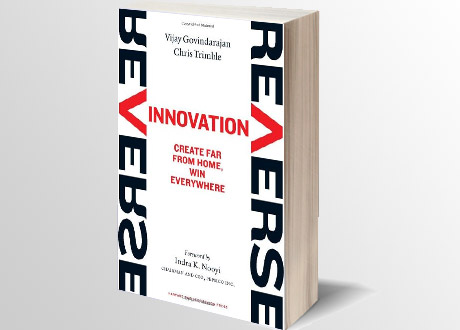
Book Review: Reverse Innovation
Though not a new concept, “reverse innovation” is hardly straight-forward in practice. Govindarajan and Trimble’s showcasing of successful projects, Fortune 500-type best practice and essential theory in the field endeavors to lay down a modus operandi, yet one which lacks a lasting echo. In this review Jeffrey Phillips argues that despite its good intentions, the book seems to cater only to multinationals, ignoring the needs of small/mid-sized players whose drive is high, yet resources low. Reverse innovation requires a different mind-set, workflow and altogether pace for socially and economically consistent results to emerge.
Five Ways to Commit Innovation Suicide
Customers change. Competitors change. Technology changes. If you don’t do anything, new and competitive products catch up and overtake your products and services quickly. A study by A.D. Little has shown that the life cycle of products has decreased by factor 4 the last fifty years. So innovation is essential. But it is time consuming. It demands a lot of resources. And a positive outcome is very uncertain. In this blog Gijs van Wulfen offers a helping hand by identifying five common mistakes to avoid.
Artificial Photosynthesis Powering Up
Photosynthesis is ubiquitous, but not easy – for humans. Although plants do it, humans find it more of a challenge: but we are making progress on a number of fronts. The potential long term is almost limitless supplies of low carbon energy; clean fuels for cars, planes and ships; and fundamental change to the nature of the global economy.
Finding Your D. Money: the Three C’s of Critical Question, Community & Commitment
We prize our time. People who practice collaborative innovation know they cannot monopolize the waking hours of their sponsors and communities. In this article innovation architect Doug Collins explores the three C’s of critical question, community, and commitment. Practitioners raise the odds that everyone involved in collaborative innovation will view their time as well spent when they help sponsors address the three C's in authentic ways.
Why is Innovation so Often “Hit or Miss?”
This question has baffled many executives for quite some time. Management tries to replicate the special event or circumstances that created a successful innovation project but often fails. Companies have created positions such as Chief Innovation officer, innovation teams, and organizational strategies that promote innovation through diversity, team dynamics, and social networking. However, failure rates of 90% are common when innovations occur due purely to chance. What distinguishes whether an innovation is hit or miss?
Innovation and the Art of Riding an Elephant
In trying to understand why we act in a predictably irrational ways, for example choosing short-term instead of long-term rewards, Bengt Järrehult uses the metaphor of the mahout and elephant to depict the different parts of the human brain and it's processes. In an innovation effort, how can you direct the mahout and motivate the elephant?

Pulp Innovation Chapter LXV: The Communication Factor
Any experienced consultant knows that effectively communicating the goals, purposes and outcomes of an innovation effort to the workforce is vital to the project's success. Can Marlow manage to convince Accipiter's management of the importance of their communication plan?
Open Innovation: Colgate’s Sensible External Partnership Approach
Ken Klimpel, Colgate Palmolive's Worldwide Director of External Innovation and Outreach shares his perspective on some aspects of the approach he and his company take to drive their open innovation successes.
4 Steps for Top Executives to Execute on to Truly Empower Innovation
Why would a company that rose to prominence based on its innovativeness abandon its lifeblood when the founder exists the building? There are many examples of this happening out there. However if they follow in the footsteps of the world’s ‘serial innovators,’ leadership can keep a company’s innovation flame lit without having to bring back the founding CEO.
Global Paradigm Change
The world is changing rapidly and fundamentally. Among other things, this means that business as usual is no longer an option. Far-sighted leaders know this, and are already adopting new purposes for their organisations that reflect the need to be kinder to society and the planet. Although this shift builds on concepts such as the triple bottom line, it goes far beyond this: first, it is about transformation, i.e. deep systemic change, rather than reformation, trying to make current outdated systems work better; and second, it will involve significant changes in our own personal beliefs, mindsets and behaviours.
The Eastern Way: How Chinese Philosophy Can Power Innovation in Business Today
In spite of spectacular economic growth, China is still afflicted by criticism that its traditional culture inhibits innovation. However, Chinese culture is now changing in response to fundamental techno-economic shifts, and philosophy is not the same as culture. This article shows how an unconventional synthesis of Chinese philosophical systems can power innovation opportunities in 21st century business—and not only for China.
Pulp Innovation Chapter LXIV: Accipiter’s Innovation Charter
Marlow is eager to get his client new products and services to stave off a lot of overseas competition. Now he just needs to identify the most significant challenges or opportunities and begin to define their risk tolerance.
Open Innovation: The Technology Scouting Uncertainty Principle
In any supplier/customer relationship, both sides (but quite often the supplier) desire clarity regarding the certainty of the relationship. When there is uncertainty, there is angst. Some of this is natural and necessary. However, Michael Fruhling believes that in open innovation it is needlessly excessive. How can it be reduced?
To get Innovation…Try Stimulation
There is a saying, “horses for courses”. It means that certain character types (horses or people - or others) perform in different ways depending upon the circumstances. This holds true in collaborative engagements, whether they are crowdsourcing exercises, virtual focus groups, online research communities or a growing number of other online activities. A key success factor that we found over the last number of years -- and perhaps the key success factor-- is understanding what the best stimulative environment is for that activity, and your participants.
Using Strategic Intelligence Platforms to Advance Innovation
Leaders need to develop a ‘habit of knowledgeability,’ according to Haydn Shaughnessy, who has written extensively on change and innovation for Forbes, WSJ, InnovationManagement and HBR, among other noteworthy publications. In this article, Harun Asad expands on this notion and suggests how to build and implement a strategic intelligence platform that facilitates advancing innovation.
Every Day Innovation: Where Have you Experienced it?
Innovation can comes from every corner of every day life: the last great novel you read; the cereal package that was easy to open; the microwave dinner that didn't suck; the next use of air and balls from Dyson; the machine that made your coffee; the noteworthy car rental experience in Indianapolis. What recent experiences inspired you?
Applying Collaborative Innovation to Agile Software Development
The agile model for coding software rewards developers with more satisfying work and clients with more useful applications, sooner. Software developers who embrace agile principles face two challenges, however. We work globally: people cannot collocate. We source work by fiat: teams cannot gel to pursue challenges that engage them. In this article innovation architect Doug Collins explores how people can apply the practice of collaborative innovation as a means to realize the promise that agile development offers.
Pulp Innovation Chapter LXIII: Searching for Pioneers
Everyone is for innovation until someone has to be innovative. Marlow and Susan are searching for one of the core business units to step forward, with the hope of creating interesting new products and drawing the attention of the rest of the company. Who is willing to be Accipiter's innovation guinea pig?
How to Court Serendipitous Network Intelligence
Most innovators understand what serendipity is. Dictionary.com calls it "an aptitude for making desirable discoveries by accident." But have you ever heard of serendipitous network intelligence?
The 66-Point Innovation Checklist
Gijs van Wulfen has developed a structured innovation approach connecting creativity and business reality in five steps: Full Steam Ahead, Observe and Learn, Raise Ideas, Test Ideas and Homecoming. Here he summarizes the benefits of his method in a 66-point innovation checklist.
Managing the Emotional Debate
Science has caused controversy for centuries. But scientific developments, such as addressing climate change, applications of biotechnology, and the use of stem cells or GM crops, and the resulting debates are becoming ever more central to our national economies and global wellbeing. Influencing those debates is, as a result, becoming more important to those on all sides of the arguments and those debates becoming ever more polarised; and protests increasingly violent. The greater part of the problem may not be public understanding of science, but rhetoric and values. Managing the emotional debate may be critical to future policy development and science based industries.
The Team Diversity Sweet Spot
Team diversity is conducive to innovation. When R&D project teams are composed of people with different skills, competencies and knowledge, the likelihood for new thinking and innovative solutions increase. However, too much diversity may lead to breakdown in communication and ensuing conflict. There is a sweet spot in how much diversity R&D teams should have.

Making Innovation Pay: Driving the Move from Innovation-Talk to Innovation-Do
This IM Expert Panel Discussion on making innovation pay offers insights on new methods to increase the rate of innovation, reduce individual level costs per innovation and encourage fail fast methods. This session is all about unusual ways that organizations have managed to drive innovation execution to make returns on their innovation investments and the key learnings that can be applied and replicated in your organization.
Big Data & Digital Technologies Transform Businesses but Lack Capabilities
According to McKinsey’s first annual survey on the topic, most C-level executives say that the three key trends in digital business are big data and analytics, digital marketing and social-media tools, and the use of new delivery platforms such as cloud computing and mobility. These form the strategic priorities at their companies. However, they also report some tough challenges. Nearly half of respondents say their companies’ investments in digital initiatives are too small to deliver on their goals.