

Measurement is Critical to Increase Return on Innovation
Innovation is so important that most senior executives say that it’s integral to their company’s success. Because companies invest so much in it, getting a return is critical. Poor measurement practices result in bad or incomplete information, wasted resources, and a lower return on innovation investments. InnovationManagemenet asked James Andrew, senior partner of BCG and coauthor of the senior management survey Measuring Innovation 2009 a few questions about the importance of measuring your innovation efforts.
Improvisation is an essential element of the new paradigm of work, says Jay Rhoderick
What does improvisation have to do with the needs of business today? Plenty, says improv expert Jay Rhoderick, who shares some practical strategies for using it to break out of our rutted thinking and generate new insights.

Successful Approach for Improving Innovation Management for SMEs
It's a well known fact that Europe's competitive potential is dependent on the capacity to be truly innovative and creative in launching new successful products and services. This can be a daunting challenge for many organizations, not the least for small and medium sized enterprises that often lack proficiency in innovation management. IMP³rove is an approach developed especially to meet the needs of SMEs to help them develop innovation management performance with sustainable impact.
Creativity is an essential change management tool for effective leaders, says Marci Segal
Creativity is more important than ever, considering today's accelerating rate of change in business, says author and expert Marci Segal in this latest Creativity in Business interview. In fact, it's an essential change management tool for effective leaders.
The inherent dangers of incrementalism
It may seem that tweaking existing offerings may be the safer or more provable approach, but the world may be changing too quickly or in very broad ways, ways in which an incremental approach may be insufficient for long term growth.
What the Self-Organizing Principles of Improv Theater can Teach Us About Business Creativity
Michelle James explores the fascinating connections between adhering to the principles of improvisational theater in a performance and being able to adapt, create and improvise effectively in the work place.
Ideas management: What if there are no ideas?
‘Innovation starts from the top’ is a frequently used phrase; but there are many steps involved in a successful innovation strategy. What unfortunately I too often see, and in many organizations, is a huge gap between top management thinking and the understanding in the rest of the organization about innovation. Everybody might agree that innovation is important in principle. They might even be in agreement about the particular process that could bring new ideas to fruition, and implement new thinking in an innovation. This is all fine – but what if there are no new ideas?
How to look for innovation inspiration outside of your industry
Emulation is a viable technique for driving innovation. However, one has to look outside of their current industry for it to have any real value, often very far away from that industry.

How to Use a Morphological Matrix to Generate Ideas
A morphological matrix is a powerful tool for generating ideas, based on potential variations in a problem's characteristics.
How to lead creatively and inspire your people
If you're a manager who wants to lead creativity effectively, there is hope and support available. You could be remembered as fondly as Herb Brooks is remembered by the 1980 U.S. Olympic hockey team. He's the guy who helped them achieve a miracle.
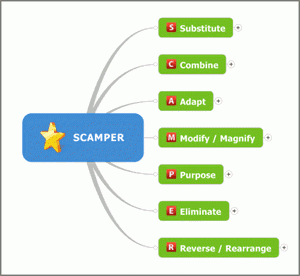
SCAMPER your way to greater innovation
SCAMPER is a productive and versatile technique for generating innovative ideas for your product or service. It forces you to look at your offering from seven different perspectives. Paul Sloane explains, and gives some examples of companies that have used this popular and highly effective technique to generate innovative products and services.

Web-Enabled Open Innovation: From Hype to Reality
InnovationManagemenet is proud to present yet another experienced and knowledgeable columnist; Ehsan Ehsani, researcher and consultant in the area of innovation and product development. Ehsan is working with Accenture Product Innovation and PLM practice in New York City Office and has previous experience from a variety of firms both in Europe and the United States. This is the first in a series of columns starting off with a hot topic: Web-enabled open innovation.

Nordic countries score very low for their innovation efficiency
Today’s business leaders view innovation as a means to fight the financial crisis, however a new European study by INSEAD and Logica warns that the link between the money spent and the final result is broken. Their findings show that the majority of business leaders commit substantial resources to innovation, but only nine percent use ROI as a measure of innovation. What’s more, the Nordic countries achieved the lowest rating when it comes to measuring and implementing innovation.
Whether more R&D Investments brings more Innovation Output
Common sense says that if one wants to improve the innovation output, one needs to either (a) increase the size of the opportunity set that goes in the so called 'Innovation Funnel' ; (b) Speed up the throughput of the 'Innovation Funnel' and/or (c) improve the variety of the opportunity set passing through the 'Innovation Funnel'.
It’s time for a resurgence in creative leadership and processes, says futurist Frank Spencer
Futurist Frank Spencer believes that the global economic recession and mechanistic organizational structures have driven creativity out of most firms. It's time for a resurgence in creative leadership and processes that will transform our thinking and actions.

In Search of Failure – Designing for Failure?
Who would be searching for failure? Failures just happen, though we always hope to avoid them. A vile thing, a vile word, no? Read more in this weeks' column by Bengt-Arne Vedin, PhD and Professor emeritus in innovation management. And why not joining in helping Bengt-Arne improving the article by joining the discussion?
Market Orientation Supports Innovativeness Over Time
We know that clusters of co-located firms play an important role in supporting innovation and wealth creation. Spatial proximity can allow firms to take advantage of scale and positive externalities such as access to skilled labour, specialized subcontractors and rapid flows of information. Shared history, trust, and common understanding of phenomena may also enhance cluster members’ ability to interpret, and learn from, each other’s strategies. Yet location in regional clusters in and of itself does not guarantee success.
Creativity is at the heart of 21st century work, says Dan Pink
NYT best-selling author Dan Pink shares some valuable insights into the new paradigm of creative work in this Business Thought Leader interview.
How to use Twitter as a Powerful Idea Discovery Tool
Twitter can be a powerful tool for developing breakthrough ideas. In fact, it's one of the best tools for exposing you to new ideas, insights and trends. Unfortunately, it has gained a reputation as a place where narcissistic people talk about the glorious minutiae of their lives - such as, "Guess what I'm having for breakfast?" There is some of that, of course, but it is also a vibrant community where people share some amazing ideas and resources.
Innovating with CSR
I happened to learn about a new book by the legendary Charles Handy when I visited him a couple of months back at his home in Norfolk England ' the new philanthropists'. True to the title of the Book of probably Britain's most prolific management thinker (together written with his wife Elizabeth who is a portrait photographer), Charles talks about a new trend of successful young businessmen who don't only believe in giving money for just causes but by working on the spot with the needy so as to create a sustainable impact. He offers examples from entrepreneurs from South Africa, Ireland and Australia among others.
Danish Innovation Centres in Global Hot Spots
Gaming week in Silicon Valley, development of sustainable houses in Shanghai, and medico innovation in Munich – what do these things have in common? They are all projects set in motion by Danish innovation centres in order to strengthen the innovation and competitiveness of Denmark. And you are invited to join.

Learning to Trade and to Innovate at the Base of the Pyramid
Is sustainable business the missing link in alleviating poverty and boosting global trade and prosperity? If so, how should companies exploit this opportunity in practice? Louise Koch, Danish Anthropologist and Business Innovator, talks about best practice, mindsets and resources for sustainable, people-centred innovation in developing countries.
Three levels of open innovation maturity
There are three levels of open innovation maturity: externally aware, fully integrated and ecosystem orchestration. Innovation and growth performance improve as maturity increases.
What is lateral thinking?
Lateral thinking is one of those terms that many people have heard of, but probably very few of us really know what it means. So when I saw a very clear definition and description of it in Paul Sloane's excellent new book, How to be a Brilliant Thinker: Exercise Your Mind and Find Creative Solutions, I couldn't resist sharing it with you.