


Back End Commitment: Now You Have the Idea
People who sponsor collaborative innovation challenges establish a quid pro quo with the contributors and collaborators who comprise their communities. They agree to “do something” with the ideas that resonate with the community. What might “do something” entail, exactly? In this article innovation architect Doug Collins speaks to sponsor commitment on the back end of innovation, where ideas morph into tests, prototypes, and concepts.

How To Innovate The Expedition Way
Innovation is essential. But it is difficult and risky. Inspired by great explorers like Columbus, Magellan, Amundsen, Hillary and Armstrong a method for ideating new concepts was developed, designed as an expedition.
Governing Innovation in Practice – The Role of Top Management
What role does the C-Suite have in exercising the company’s innovation governance responsibilities? In this article, the last in a series of five, professor Jean-Philippe Deschamps, defines six domains that are essential to organize and mobilize for innovation. They will condition the way innovation will be carried out and sustained by the organization and hence belong to the prime innovation governance duties of the top management team.

Balancing Innovation Via Organizational Ambidexterity – Part 1
Organizational ambidexterity is becoming a Key Factor for Success in many industries. With a proper ambidextrous set-up, firms can optimally balance radical and incremental innovation.This is part 1 of a 3-part article co-written by innovation-3’s Frank Mattes and Ralph-Christian Ohr from Integrative Innovation. In this article we are showing the need for organizational ambidexterity, introduce the concept, show how it can be implemented and provide two case studies from leading German firms

Becoming a World-Class Innovator
A common misconception today is that innovators are innately creative people. Specifically, many people think that innovators are born with intuitive skills and views of the world that differsfrom the rest of the population. This is simply not true. Innovators aren’t born, they’re made. But we can learn from a few key attributes that leading innovators share.

Driving Collaboration – Diverse Opinion is the Key to Innovation
We know the value of collaboration in traditional innovation activities, but systemizing the process helps to increase the diversity of opinion available early on in the process. In this article we share insights on driving collaboration between your employees.
Governing Innovation in Practice – The Role of the Board of Directors
Is innovation part of the governance mission of boards of directors? At first sight, the answer seems to be “no”. In this new series of two articles professor Jean-Phillipe Deschamps delves deeper into the specific role of the board of directors and that of top management in exercising their innovation governance responsibilities.
Innovation Governance – How Well Does it Work?
This series of articles has explored the definition and scope of innovation governance as well as the different organizational models that companies typically choose to allocate responsibility for innovation. This last article will discuss questions linked to the perceived general effectiveness or inadequacy of innovation governance endeavors, and it will characterize the managers’ level of satisfaction or dissatisfaction with the various organizational models that their companies have adopted.

Fertile Ground for the Ideation Seed
Depending on the people involved, their motivations, and the phase of the moon, you may or may not find fertile ground for the practice of collaborative innovation. In this article innovation architect Doug Collins explores the fecund places that you, as a practitioner, may want to think about planting your seed of ideation to ensure a bountiful harvest.

9 Different Models in use for Innovation Governance
Research from Jean-Philippe Deschamps, Professor of Technology and Innovation Management at IMD, indicates that there are at least nine possible models of innovation governance, some of which are more widely used than others. This second article in a series of three on the topic of Innovation Governance will review the various governance approaches or “models” that companies have put in place.
Innovators get better with age
The stereotype of an innovator is a youngster bringing his dream alive like Mark Zuckerberg of Facebook, Bill Gates of Microsoft, and Steve Jobs and Steve Wozniak of Apple. But they are not the rule. They are the exception.
Leading an Innovative Company
Having a reputation as an innovator is the ‘holy grail’ in business today. Leaders and companies want to be seen as innovative, and be tied to the many associations that come with it: creative, marketing leading, cutting edge. Leading business publications including Forbes, Fortune and Fast Company celebrate and publish an annual list of companies they consider innovative.But what is it to be innovative, and how do leaders foster it within their company culture?

What is Innovation Governance? – Definition and Scope
Innovation governance can be thought of as a system of mechanisms to align goals, allocate resources and assign decision-making authority for innovation, across the company and with external parties. In this series of articles, professor Jean-Philippe Deschamps delves deeper into this topic; what is innovation governance, what different models are there and which ones seem to be the most effective?

How to Increase Engagement in Enterprise Innovation and Develop a Sustainable Program
Maintaining and building high-quality engagement over time should be the focus of all innovation managers as they strive to develop sustainable enterprise programs. This article shares key activities you can undertake in order to boost engagement with your program.

The Secret of Innovative Companies: It Isn’t R&D
In rejecting the limiting belief that innovation is R&D’s job alone, leaders of highly innovative companies work hard to instill “innovation is everyone’s job” as a guiding organizational mission. In this article, co-creators of Innovator’s Accelerator, Jeff Dyer and Hal Gregersen share insights and examples to follow in order to ensure innovation starts at the top and reaches the bottom of your organization.

Exclusive interview: Richard Li-Hua on The Integration of Western Management with Eastern Philosophies
The discussion around integrating Western Management with Eastern Philosophies has gained considerable traction, and for good reason - both Europe and China have undergone significant transformations during the past 30 years and collaboration has never been more relevant than in the post-recession context. In this exclusive interview, Professor Richard Li-Hua discusses the key considerations around this topic and indicates how innovation managers can benefit from this integration.

Measuring Innovation part 2: Dark Innovation
Many activities in organizations that are considered innovative risk being missed if we solely use the standard toolkit to measure innovation. In this article we will look at three types of scales that measure intangible aspects of innovation that are easily added to the toolkit of any organization.

Using Communications to Drive Innovation – How to Develop an Engaging and Sustainable Program
Enterprise innovation has one main goal – developing business value. There are many different elements that support that goal, but one of the most crucial is communications. As mentioned in the previous article in this series, software has a key role to play, but it doesn’t guarantee employee participation or value to the business, we need to think more widely to address these needs.
How Status Quo Bias Can Kill Innovation
Status quo bias is a proven cognitive bias that exists in all normal people. Innovation, especially breakthrough innovation, requires veering from the status quo. As a result, the average managers is all too likely not to approve a highly innovative idea, not because of any intrinsic flaw in the idea, but because the idea would require change. You need to work around this bias if you truly want your company to innovate.

Understanding your Innovation Culture – A Case-Study from Swisslog
InnovationManagement is delighted to present a brand new Case Study highlighting the challenges of creating an innovation culture that: supports new product/service development initiatives, facilitates the creation of idea campaigns, spurs employee engagement and develops business value. In this article, Colin Nelson, Director of Strategic Consulting at HYPE Innovation, delves deeper into how collaborative innovation challenges were identified, managed and successfully overcome at Swisslog.
What High Growth Companies Share in Common
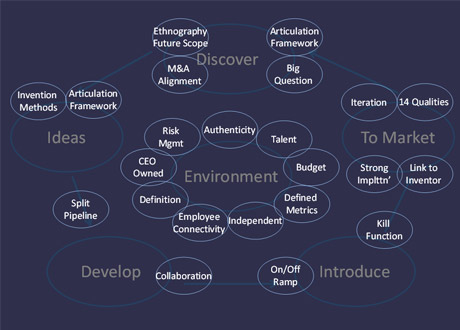
Over the past six years The World Database of Innovation initiative has uncovered the world’s first statistics behind the practices that allow large organizations to grow and to innovate. In collaboration with innovation leaders and other experts Uri Neren and his team found 27 management structures, processes, and cultural practices are shared by the world’s fastest growing companies that make what could be called an “Innovation Management Equation.”
Unlocking Talent is a Key to Organizational Agility and Innovation
Nilofer Merchant, in her excellent new book, 11 Rules for Creating Value in the Social Era, points out that in order for companies to be fast, nimble and innovative enough to survive in today's Social Era, leaders must meet their workers' desire to contribute to a mission that matters.
The Persuasive Innovator: Influencing People to Collaborate
When you introduce the practice of collaborative innovation to your organization, you make the case to your colleagues that the approach will benefit them more than the status quo. Why might they agree with you? Why might they change their beliefs and behaviors? Have you developed your campaign of persuasion? Innovation architect Doug Collins shares his thinking on how you might influence people to share your beliefs about the benefits of the practice.
Creating Innovation Cultures in Companies: CEOs, People and Collaboration Tools
This article shares two strategies that are proving most effective for CEOs that aim to make their companies more innovative: developing a creative culture (people’s behaviors) and applying new processes and technologies.