

Keeping a Constant Flow of Innovations at BASF
InnovationManagement recently spoke to Dr Thomas Weber, Managing Director of BASF’s Future Business, about what it takes for a large company to maintain a constant flow of innovation ideas and a spirit of enthusiasm to feed the pipeline.
Tips to spark your creative genius at work
Imagine showing up to work each day truly happy that you are there, getting energy from your colleagues, having fun in meetings, feeling like what you do counts. It is possible. You just have to create the conditions that help you to spark your creative genius.
Defining an Innovative Firm – It is Much More Than Technology
Innovation is very much the word of the moment. We hear it used in science, the arts, in politics, in society, and often for good reason. For example, the creation and building of the European Union, is one of the most innovative – and indeed frustrating – processes in history. So what actually is innovation? Read more in this article by IMD professor Georges Haour, IMD, one of the world's top business schools.
Top 10 Reasons for Open Innovation Failure
A recent 15inno Twitter Chat made me ponder on the worst and most common mistakes that companies do on open innovation. Here comes a list of my thoughts – still work in progress.

The Open Innovation Revolution- essentials, roadblocks and leadership skills
In this book review Paul Hobcraft has taken the opportunity to go through Stefan Lindegaard’s book “The Open Innovation Revolution- essentials, roadblocks and leadership skills” published by Wiley.
The New Dutch Economy: Innovative, International and Involving
The Dutch Innovation Platform, a think-tank established by the Dutch Government, recently released a report Nederland 2020, Back in the top 5 outlining the steps the Netherlands needs to take to regain its former position in the top 5 of the World Economic Forum’s Global Competitiveness Index (GCI). In this article Rob Blaaboer, contributing editor from the Netherlands, suggests a way to reach the New Dutch economy, i.e. innovative, international and involving, and how to get back in the top 5.
The Power of Provocative Questions for Creative Problem Solving
Many of us don't give questions a second thought. They're a part of how we gather information from others on a daily basis. But did you realize that asking yourself provocative, thought-provoking questions can be a powerful catalyst for creative problem solving? Here's how.
How Biases, Prejudices and Ignorance can Quietly Undermine Innovation
The missing ingredient of innovation may lie in the human ability (or lack thereof) to see the world from someone else's perspective and take action on the insights that this ability can reveal.

How to increase your odds of serendipity with Twitter
Twitter is a great tool for serendipity. How can you increase your odds of bumping up against great ideas there that you can potentially use in your business?

Innovation Strategy: Hurdles are for Leaping Over
The biggest hurdle to innovation is probably allowing hurdles to become insurmountable. The thing to remember, however, is that hurdles are for jumping over. The best method of jumping over innovation hurdles is through creativity and innovation.
Recruiting Tomorrow’s Innovative Minds
Amid news headlines of financial crisis and unemployment rates, China is moving ahead, steadily bouncing back from any dips in the country’s growth during the last two years. Multinational companies in China are bracing for a renewed talent war of job-hopping and poaching, as economic growth accelerates. Although the talent war will likely emerge first in the East, it will spread to become global as demographic shifts become more pronounced. InnovationManagement interviewed Sam Kondo Steffensen, CEO of MillionBrains, to get his perspective on how talent should be recruited and managed.
How to Develop a Creative ‘Elevator Pitch’ that Captures Attention and Interest
To sell ourselves and our big ideas, we need elevator pitches that stand out, are unique and stimulate a response. Clearly, some creativity is what is needed to design such a pitch. Jeffrey Baumgartner explains how to develop one.
Technology Scouting: Rethinking the Innovation Toolbox
Companies should reconsider their technology scouting strategies to proactively seek, identify and access external knowledge, skills, capabilities and intellectual assets. These may or may not be applicable to their current needs. However, these resources could quickly be activated to help address new challenges as they arise. Sort of an innovation toolbox, according to Michael Fruhling.
Stumped by a problem? Try adopting a different perspective!
If you're faced with a seemingly intractable problem and you've tried everything you can think of to solve it creatively, perhaps you need to try a different perspective.
3 ways to assess your organization’s innovation health
For innovation to thrive in an organization, three conditions must be present. If any one of them is suffering, then innovation will likewise suffer. Here is what to look for to assess your own organization's level of innovation health.
Predicting the future of innovation
A number of emerging trends, if extrapolated into the future, provide hints on the future of innovation.
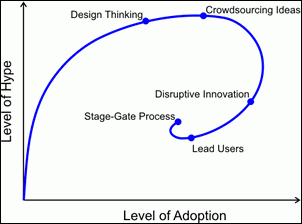
The Innovation Hype Cycle
According to the Gartner Hype Cycle model, media coverage of a new technology goes through five distinct phases. Graham Horton has discovered that the way media treats innovation follows a similar pattern.
Crowdsourcing 2.0: user-centred innovation meets social media
President Obama ‘crowdsourced’ a part of his political agenda with his change.gov initiative, which embraced the conversation and allowed users to identify topics that were important to them and vote on their relative importance. The addition of social media tools and philosophy to the mix resulted in a perfectly ordered list of the political issues that mattered most to US citizens.
10 tips for finding creativity later in life
Middle age can be a marvelous time in our lives, if we let it. It can actually be a phase of life in which our creative energies catch fire, when we can truly make a difference in the world with our ideas, art, music and other forms of self-expression. Here are 10 tips for finding your creative muse later in life.
To Innovate, Forget about what the ‘Experts’ Say
Experts tend to be notoriously wrong in their assumptions, especially regarding the impact of new technologies. So don't focus your strategy or innovation efforts on their perception of what the future will or won't look like.

Innovate to Thrive –The Importance of Inspiration
This is the first in a series of articles that take the need of Innovation under the loop and share some of the imperatives, must have’s if you will, to create and sustain “NEW” in business or organizations. The material is based on 25 years of hands on experience in the innovation space and the recently published book “Robert's rule of innovation”.

Creativity is a core value for leaders navigating uncharted waters, says Seth Kahan
According to leadership author Seth Kahan, navigating uncharted waters which often gives rise to anxiety and uncertainty. Visionary leaders learn to work with that energy and transform it inside themselves into creative progress.
Discover New Possibilities with Reverse Innovation
Before the radical shifts in technology disrupt the industry fabric, there exists a great potential to appropriate value from the market through incremental product and business model innovations. The less intense the competition, less matured the market - larger is the potential. The emerging markets of the world the BRICs (where s could stand for the plurality as well as South Africa), have long been projected as the markets to invest in.
Ecosystems and the formal process of ad hoc innovation
Look at an example like Nokia and you can see the mobile device and services giant rapidly evolving different types of ecosystems around its devices, services and solutions – these are all ad hoc innovation platforms or ways to introduce the unplanned into corporate strategy. Ad hoc innovation is extremely important but a poorly understood element of change. Yet companies have been evolving complex ad hoc innovation systems for perhaps the past three years.