

9 Steps for Establishing Your Employee Engagement Plan
You've got the best employees on the planet, right? They work hard and are experts in their fields. But, somewhere there is a disconnect. The culture of your organization is not everything it could be, not everything you would like. Is there a way to ensure that your employees hold to the same values you do throughout your department, or the organization? How can you empower your employees, and foster trust, growth, and loyalty? Here are nine ways to fully engage your employees.
Who Are the Great Innovators Among Us?
Humans are innately concerned with what makes up the creative inventors among us. We want to know how to cultivate our inner innovator and nurture those qualities that will serve us both as individuals and as employees.
Behavioral Innovation: The Need to Pivot, Why We Don’t and What We Can Do About It
When was the last time you seriously thought about your blue chip investments going broke? At what point will those shares be worth nothing? Although it may sound ridiculous, the question is serious because at the current rate of disruption, half of the Australian Stock Index S&P 500 will be replaced over the next 10 years (Anthony S D et al, 2016). Where does that leave your investments?
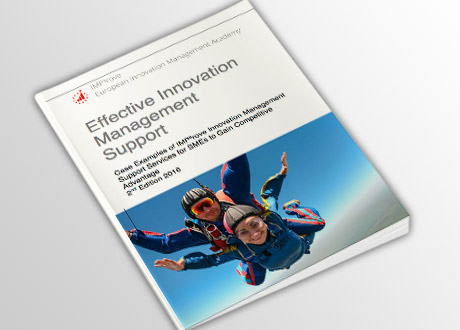
IMP³rove Report: Effective Innovation Management Support
This collection of case examples of IMP³rove innovation management support services for SMEs to gain competitive advantage illustrates the needs of key stakeholders in the innovation ecosystem. The case examples show how a wide variety of effective support services utilising the IMP³rove offerings address these needs.

5 Emerging Trends in the Financial Sector
The financial landscape is changing and the crowd is uniquely suited to help banks and other financial institutions solve some of the challenges they face. In this article, we look at five tech trends and how they’re changing how financial institutions interact with their customers.
The (Non)Sense of Employee-Focused Innovation Training
A lot has been written about Innovation Training in the recent past. At Culturevate, we clearly see the sense of such training, but there are some important conditions that needs to be met for these efforts to generate long-term impact for an organization. Not all companies understand these conditions, which often leads to mediocre results and missed opportunities. One extra difficulty is that a good Innovation Training should be driven by and aligned with several functional parts of a large corporate organization.

Innovation that Matters: Tomorrow’s Winning Cities
Innovation that Matters examines and ranks 25 cities’ readiness to capitalize on the inevitable shift to a digital economy. It carves out critical trends every U.S. city leader can learn from and offers recommendations local leaders can adopt to strengthen their region’s digital competitiveness.
Innovate as a Team? Work on Your Psychological Safety!
To be able to use the full potential of innovation, psychological safety within teams and organisations is essential. Psychological safety is the shared belief that it is safe within the team for interpersonal risk taking. There is a direct relation between a psychological safe climate and performance of the team. (Edmondson 1999)
Why Innovation Fails (And How to Succeed)
Here’s a wild guess: the majority of large enterprises will probably claim they know exactly what innovation is all about. Yet, in spite of impressive resources, big companies are responsible for only a small fraction of disruptive innovations. What is at the root of this paradox? Why does so much innovation fail? And more importantly: what can companies do about it?

Understanding the Innovative Mindset: Can it be learned?
Where do creativity and innovation come from? It’s an age old question: are creativity and innovation innate abilities, something you’re either born with or not, or can they be learned? While the debate continues, the data is increasingly pointing to the fact that qualities like creativity and innovation are largely learned behaviours.

Platform Disruption Wave
In the new global environment innovation is tending towards Platform Disruption, and is more focused on waves of change than single technology disruptions. The competitive capability of different innovation cultures, rather than technology, therefore becomes the critical success factor. In this article, Haydn Shaughnessy examines product and service platforms as the new organisational form and suggests that modern enterprises need to take the leap to a new way of business.

Why Crowdsourcing is Critical to the Future of Education
Educational institutions have the reputation of being slow-moving behemoths, but this label is undeserved. According to the Organization of Economic Cooperation and Development, the educational sector worldwide is more innovative than it gets credit for.

Digital Shoring for Networked Innovation
Companies are under pressure to innovate faster than ever, and collaboration beyond organizational boundaries is central to accelerated innovation. But few companies navigate collaboration well—or even find the right path to get started. To move forward, companies must change their operating models to enable “digital shoring,” the latest evolution of organizational “shoring” approaches.

How to Implement Design Leadership in Your Organization
While discussing the role of a designer in a corporate context, Lee Fain (Design & Innovation at Electrolux) and Anthony Ferrier (CEO, Culturevate) exchange views on a number of questions that are critical to the implementation of design leadership: How can design leaders scale their influence? Does the designer’s representation need to come directly from a designer, or can it come from another leader with an interest in design? Finally, where does design typically sit within an organization? Join us for this latest clip from Innoview - a new interview series with a focus on developing cultures of innovation and intrapreneurs within corporate settings.

12 Tips for New Business Owners in the First 12 Months of Their Company’s Life
If you are starting a new business you may be feeling a little overwhelmed by the number of decisions you need to make. You may wonder what secret tricks successful business owners used to ensure that their companies grew in the right direction. Here are twelve tips that you should use in your first twelve months in order to make sure that your company has the best chance to succeed.

Do You Know the Seven Stages of Innovation?
At IdeaScale, we define prolific innovators as organizations that have moved more than half of their ideas to the final stage. This doesn’t necessarily mean that every suggested idea became a value-generating, implemented reality. This means that the completed ideas had each been investigated, responded to, and a decision was made to move forward or not. But of course, at least a portion of those completed ideas generate measurable constructive outcomes.

Six Levers For Solving The Corporate Innovation Problem – Part 3
This is the third part of a three-part article series. We are investigating why – despite all the investments made into the early phase of innovation – innovation results remain disappointing. We call this the “corporate innovation problem”. In the first part we illustrated that companies are investing heavily into the early phase of innovation. In the second part, we provided some metrics on the corporate innovation problem and found that the corporate innovation problem actually consists of a “complexity” problem” and a “system problem”. In this article, we show six levers to change the “system problem” and think this is the way to solve the corporate innovation problem – and ultimately to increase innovation performance.

Innovation Tautogram — A Simple and Powerful Innovation Tool
The human vocabulary with millions of words is adequate to explain all of our expectations and experiences, even those which are imagined. Why not harness the power of language to discover new products and services? Author Shanta R Yapa shares the Innovation Tautogram technique, which can be used as an individual or a group exercise.

Everyone Talks About Innovation … But What is it Really?
From manufacturing to accounting: in every sector, organizations sooner or later declare themselves ‘innovative players’. Sad but true: as a mantra for businesses far and wide, ‘innovation’ too often becomes a catchphrase devoid of meaning. So let’s break it down and get back to the nitty-gritty: what is innovation exactly, and why should you care about the word’s core meaning?
Six Levers for Solving The Corporate Innovation Problem – Part 2
This is the second part of a three-part article series. In the first part we illustrated that firms are investing heavily into the early phase of innovation. In this second part we show that despite of all these investments, innovation results remain disappointing. We call this the “corporate innovation problem”. We provide some metrics and find that there are two root causes. In the upcoming third part we will suggest that six levers can be used to address one of the root causes. We believe that moving these levers can provide a solution to the corporate innovation problem – and ultimately lead to increased innovation performance.
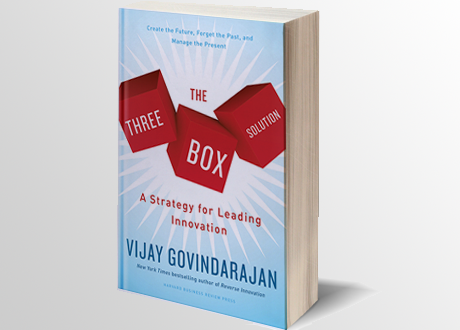
Three Box Solution for Sustainable Innovation
“Before you can create, you must forget,” writes Vijay Govindarajan (VG), one of the world’s leading experts on strategy and innovation in his latest book “The Three Box Solution – A Strategy For Leading Innovation.” Why does VG say this and what can we learn from him?

What’s the Interaction between Design and Design Thinking?
Design Thinking—a powerful methodology principally used in product design—is now influencing corporate culture, allowing everyone to be part of the creative process. Companies today are moving beyond simple brand and product design and are developing a strategic process to work more effectively and improve the customer experience. But how does this democratization of design principals within an organization effect the role and responsibilities of the designer? How does it change the way companies are thinking about design? In this clip from InnoView, Lee Fain (Design & Innovation at Electrolux) and Anthony Ferrier (CEO, Culturevate) discuss how design is changing in a corporate context.

Six Levers for Solving the Corporate Innovation Problem – Part 1
Innovation is at the top of the Management Agenda for many companies. For excellence in innovation, companies have to master the chain of activities from discovering valuable insight into unmet customer needs to successful market adoption. However, despite large and growing investments into innovation, results remain disappointing. We call this the “corporate innovation problem”. In this 3-part article series we dig deeper into this problem and find that there are actually two root causes for it. We focus on one of the root causes – the “system problem” – and work out six levers of improvement. Acting on these levers offers a solution to the corporate innovation problem and ultimately increases innovation performance.

Innovation: Knowing Where to Begin
Let me see if this situation sounds familiar: you’ve promised your boss that you’ll generate at least one percent growth over last year. You’ve been racking your brain with ideas about how to improve your product or develop a new offering or finding new efficiencies which will help your margins, but the few ideas that you’ve come up with haven’t had legs and pages keep coming off the calendar.