


Understanding your Innovation Culture – A Case-Study from Swisslog
InnovationManagement is delighted to present a brand new Case Study highlighting the challenges of creating an innovation culture that: supports new product/service development initiatives, facilitates the creation of idea campaigns, spurs employee engagement and develops business value. In this article, Colin Nelson, Director of Strategic Consulting at HYPE Innovation, delves deeper into how collaborative innovation challenges were identified, managed and successfully overcome at Swisslog.
What High Growth Companies Share in Common
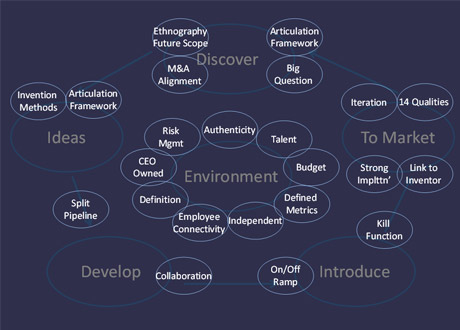
Over the past six years The World Database of Innovation initiative has uncovered the world’s first statistics behind the practices that allow large organizations to grow and to innovate. In collaboration with innovation leaders and other experts Uri Neren and his team found 27 management structures, processes, and cultural practices are shared by the world’s fastest growing companies that make what could be called an “Innovation Management Equation.”
Innovación Neuronal – La próxima gran cosa después de la Innovación abierta
Este artículo muestra como la biomimética puede ser usada de manera efectiva en el diseño de redes de innovación. Se construye a partir de las similitudes entre el conectoma del cerebro y las redes de innovación que dan lugar a un nuevo concepto de innovación – Innovación Neuronal. Este nuevo concepto demuestra cómo las organizaciones pueden alcanzar a ser competitivas con el despliegue y el uso de la innovación colaborativa.

From Chaos to Control: New Research Reveals the Global State of Resource Management and Capacity Planning
In the newly released Resource Management and Capacity Planning Benchmark Study, research is identifying best practices to avoid wasting resources on the wrong opportunities, leading to profit loss and missed market windows. Read more about the results from the study and how you can assess your company’s maturity level, determine what challenges you face, and leverage best practices shared by mature, successful companies.

An Introduction to the Book No Straight Lines: Making Sense of our Non-linear World
In his book No Straight Lines: making sense of our non-linear world, author Alan Moore argues that humanity shifts gear when it demands fundamental change to its real world circumstances and that this moment stands as a turning point in the collective approach to the organisation of the economy and society as a whole. This deeply thought provoking work is relevant for innovation management professionals in all industries, as it: challenges how we think innovation gets done, and then offers up new viable alternatives; argues that innovation can be accelerated and costs reduced; demonstrates that we need a new vocabulary to describe non-linear innovation and finally, explains how innovation can also help build a more regenerative world.

Sitting – a not so New Health Risk
Concern about how long we spend sitting is rising: new research indicates that it may be a greater health risk than smoking. Mobile technologies are also changing how we sit - badly is the answer, with new pains and problems. New lifestyles, work patterns and designs needed.

Better Living through Collaborative Innovation
Organizations big and small have begun to explore the practice of collaborative innovation as a way to increase engagement and to foment a culture of innovation. Let’s say you work for such an organization. What’s the quid pro quo when you find yourself part of the crowd from which wisdom is sought? In this article innovation architect Doug Collins wrestles with questions that you may want to ask the practice sponsors and yourself.

高等教育的创新 — 克莱顿•克里斯坦森的新书
高等教育正走向创新。克莱顿·克里斯坦森和亨利·艾琳在他们的新书《创新性大学:从高等大学的本质开始改变》中探讨了为什么这是不可避免的,而传统的大学又能为此做什么。比尔·费舍尔教授,对此趋势深信不疑,并认为这本书探讨了一个非常适时的话题。

How a Decision Room Can Enable Change and Innovation
One of the challenges leaders face in times of uncertainty and rapid change is helping senior managers to engage in bigger-picture thinking. To enable this process, a growing number of companies are creating “decision rooms” – dedicated areas that help them visualize challenges and opportunities from a number of perspectives and make better decisions.

Breaking the ISE: Mashup for Innovation Success
Mash-ups are an innovation power tool. Most breakthrough innovations are the result of combining concepts or ideas that at first glance would have no relationship with each other. Finding the relationship between concepts often breaks new ground. This article delves deeper into the concept of mashups and how you can work with it to achieve innovation success.

How To Get Anti-Innovators Up and Running?
In every organization you have anti-innovators. They are stuck in their habits; are ignorant the world is changing fast and think that they have nothing to fear. Actually, they are quite human. We all love our habits. Gijs van Wulfen explains how to get them motivated.

Electronic Sensory Expansion
Sensory substitution is a method of replacing the information flow of one sense with that of another sense. The research dates back to the 1960s and has been used in various ways to help people with physical impairments. Biohackers and other researchers have recently adopted these techniques to enhance and extend the sensory experiences of the non-impaired with potentially practical applications, some of which might even enter the mainstream market.

Getting Out of the Commodity Trap – Part II
The basics of Prospect Theory by Daniel Kahneman tell us that we hate to lose 3 times more than we love to win. This mindset, probably deeply engraved in our DNA, has implications on the way we develop and brand our products as we are more prone to reduce the drawbacks we have relative to our competitors rather than to improve our advantages. According to Bengt Järrehult this leads to commoditization.

How Can You Reuse Solutions From Other Industries?
Innovation is often more about combining what is already there than reinventing the wheel in a creative manner. In this article you will learn how to apply solutions from other industries to your problem at hand by using… metaphors. This method I am about to present is called Metaphor Safari and is based on professor Ikujiro Nonaka’s theory on knowledge management.

Implementing Ideas: Baby Steps
Big, crazy, breakthrough ideas seem wonderful when you are dreaming them up, but frightening when it comes time to implement them. Fortunately, the field personal development has a technique that you can apply: personal development planning (PDP). Jeffrey Baumgartner explains how to implement this approach to your innovation process.
Innovación de Empaques en la Era Digital: ¿Una Interfaz de Usuario más Inteligente?
El empaque es ya una forma concentrada de la comunicación de la marca, codificado hábilmente por diseñadores usando formas, materiales, colores y símbolos para contar la historia de una marca, o para hacer una innovación accesible y comprensible. Ahora que el empaque se está convirtiendo en parte de la revolución digital, ¿Cómo podemos mejorar su potencial de comunicación?
Look Beyond Given Truths to Find Innovative Thinking
Are you in a “more of the same mode” in your innovation work? In this article Susanna Bill uses two real-life examples to remind us of the need to see beyond given truths. We need to keep our eyes and ears open for the triggers presented by others. She also returns to a “golden-oldie” exercise to put ourselves off balance and open up our thinking for new opportunities.
Redefining Accreditation: From Courses to Competencies
As demand grows for alternatives to the traditional model of earning a university degree based on coursework, a new model where universities grant degrees based on skills competencies is gaining momentum and credibility.
What’s That Smell? Skunk Works® Meets Collaborative Innovation
The front and back ends of innovation test us in different ways. At the front end we wrestle with, “What problem is worth solving?” At the back end we wrestle with, “How do deliver something that offers greater relative advantage than the next best alternative?” The back end can test us the most. We tap fully our potential for leadership to produce something new—something that, in its newness, disrupts the status quo. In this article, innovation architect Doug Collins explores the link between the Skunk Works®, a successful approach to the back end developed during World War II, in the context of today’s approach to collaborative innovation.
Be an A-Tension Seeker: Why Good Ideas Stem from Irritating Problems?
All too often we see companies coming to us with a new technological advancement that they are very excited about. Sadly, having a new technology does not guarantee a winning innovation. One needs to work hard at the front end to understand what the consumer needs and how the current market offer isn’t meeting those needs. Only against this backdrop can we hope to bring an idea to market that will be truly disruptive. The following article explains.
Is Creativity the New Business Edge?
The business world is very rational. Operational excellence, financial mastery and technology savviness have become pre-requisite not to stand out as a winner but to be allowed to compete. While a hard-nosed business mind is essential to cope with the increased pressure of globalized competition, it is creativity, in the form of innovation and the ability to implement it rapidly that is fast becoming the most treasured competitive asset. Companies need to innovate in a fast yet relevant manner in order to remain competitive today and develop the game changers that will allow them to remain competitive in the future.

How To Become A Business Model Architect
Our first article in this series, titled “Include Business Model Review as a New Year Resolution”, described a method to reveal weaknesses in your business model. So, what do you do next after you complete your business model assessment and find weaknesses in one or more of its cornerstones? You find Value Accelerators (VA)™! VA’s are specific and market-proven ideas, assets or strategies that directly accelerate revenue and profit growth. This article discusses how to develop, assess and prioritize the best VAs to strengthen weaknesses in your business model. It also gives you a link to download an example of a scorecard to help prioritize the VAs.
Unlocking Talent is a Key to Organizational Agility and Innovation
Nilofer Merchant, in her excellent new book, 11 Rules for Creating Value in the Social Era, points out that in order for companies to be fast, nimble and innovative enough to survive in today's Social Era, leaders must meet their workers' desire to contribute to a mission that matters.
How to Emerge from Crisis by Knowing your Innovation Growth Opportunities & Competitors’ Strengths
Companies sometimes behave like the ostrich with their head in the ground while others emerge from the crisis like a phoenix. Not knowing with which new products or services your company really earns money is a bit like the ostrich. However there are effective means to gain transparency on innovation spending without too much effort. These tools also allow a comparison with your competitors to understand what they are doing differently in their approach to successfully managing their innovation activities. Finally, they help companies which currently struggle with the economic situation to become more effective and efficient in their innovation management.