

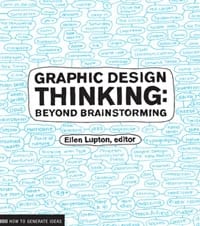
New Book Explores the Numerous Forms of Graphic Design Thinking
Visual thinking has been growing in popularity during the past several years, thanks to the rise of design thinking, mind mapping, sketching and other graphical techniques for representing ideas. A new book called Graphic Design Thinking: Beyond Brainstorming catalogues these techniques in a handy how-to format.

Pulp Innovation XV: Fitting in Innovation
In this week's installment of Pulp Innovation Marlow prepares to present a much needed innovation initiative to Accipiter's executive team.
Four Points to Consider as the Business Sponsor of an Ideation Challenge
Your organization holds you accountable for the profit or loss of one of its brands, channels, or regions. Maybe you oversee the business as a whole. You have an opportunity to apply collaborative innovation as a means to engage a wide swath of colleagues on resolving a critical business question with you. Should you proceed? If you do proceed, what points should you keep in mind to ensure you make productive use of your time and the time of your community members? In this article, community architect Doug Collins covers the four critical points to consider as the potential business sponsor of an ideation challenge.
How to Create Compelling Brand Experiences
Crafting design strategies that result in truly compelling brand experiences, products and services demands a change from traditional methods. It requires a more creative and iterative design approach, which is optimized towards identifying real human needs and addressing them with meaningful experiences. Paul Noble-Campbell delves deeper into five critical keys to uncovering those true success drivers.

Building the Blocks of Social Innovation
Social innovation advocates challenge us to make the development and improvement of modern society our primary innovation goal. This week IM spoke with Josef Hochgerner, who created the first Centre for Social Innovation world-wide (1990) and introduced a definition of social innovation which increasingly meets approval among innovation experts. Find out more about his experiences and views on innovation management.
Understanding and Exploiting Innovation Ecosystems
Do we have too static and rigid a view of innovation? It should be all about dynamic connections, imagination, experience and the interconnection of people and machines. In short it should be about identifying, understanding and exploiting innovation ecosystems, says Eunika Mercier-Laurent, author of The Innovation Ecosystem.

How to Implement R&D-Driven Open Innovation
Transforming your firm in R&D innovation approach from a closed to an open one promises huge benefits. Increased agility and effectiveness, lowered risk and revenue growth through new products are some of them. In this In-Depth Article Frank Mattes shows how a firm can find the best approach to R&D-driven Open Innovation (Outside-in) based on the insights from a number of projects in this space.

Why collaborative innovation is different than enterprise chat
Collaborative innovation, the act of inviting a particular group of people to explore the possibilities of resolving a critical question facing the organization, is a wholly different animal from the stream-of-consciousness observations one typically observes in a generic collaboration space, explains Doug Collins.
Pulp Innovation Chapter XIV: Consensus for Change?
The phone rings with a request for a presentation to introduce the innovation initiative and educate the executive team.
25 Rules for a Perfect Brainstorm
There are numerous reasons why a brainstorm session can produce few great ideas or none at all. Gijs van Wulfen gives us his suggestions for the perfect brainstorm.

Directing R&D for a Good Cause
Many innovation managers are concerned with the successful transfer of new technology from universities to industries while monitoring and protecting intellectual property. This week IM spoke with Ariadna J. Rodríguez-Diaz who is in charge of the protection of intellectual property in new technologies for education at the School of Engineering at UNAM.
How to Communicate the Value of Idea Management
The success of an organization's idea management program is at the mercy of its supporters - the employees. The innovation team and top management must effectively communicate their goals to employees so they understand what's expected of them and feel confident that their ideas will be taken seriously. Enno Scholz walks us through this communication process.

Adaptive Approach to Managing Innovation – A Practical Guide for Managers
Innovation doesn’t have to be a mystery. It can be organized and managed by people who are not, themselves, innovators. But management’s usual command and control tools are not sufficient for this task. Innovation emerges from a system whose behavior is non-linear. For this reason, management tools must be flexible and adaptive.
The Top 6 Predictors of Creative Performance in the Workplace
Is it possible to accurately predict if a person will be an effective creative thinker at work? After conducting rigorous tests, one Australian innovation firm says definitely yes.

Mastering Radical Innovation – Turning Threat into Opportunity
Radical innovation presents both a threat and an opportunity to firms. It has frequently turned entire industries on their heads. History shows us that large, successful firms may very suddenly become vulnerable when the underlying technology shifts. In this in-depth article Christian Sandström examines how radical innovation can be managed, despite the seemingly insurmountable problems created by the transition from one technology to another.
Yes, Innovation Is Your Day Job
Your plate is full. Someone graciously offers you a spoonful of collaborative innovation. Should you accept? In this article Doug Collins makes the case for why you should say “yes,” then go back for seconds, embracing collaborative innovation as your day job in order to enjoy a career in a world that values people who know how to put their insights to work.
Pulp Innovation XIII
When Accipiter leans toward using idea management software without having any clear goals, personnel or process to manage their ideas, Marlow fears the worst…
Living Well: The Future of Health and Collaborative Open Innovation
Living Well Collaborative is a new player in the innovation game and a sign of what's to come – downstream innovation management by and on behalf of users, interacting with academics and industry, jointly, to fashion the future. Deborah Mills-Scofield tunes into Living Well..

Salvador Dali’s Surrealist Paintings: A Surprising Catalyst for Creative Solutions
The way that Salvador Dali, the famous surrealist painter, approached the subjects of his paintings holds within it some important lessons for those of us seeking creative solutions.

Achieving Sustainable Innovation
Creative business solutions benefit the bottom line, but many times they can also solve environmental challenges by cutting waste and better utilizing resources. Tanja Bisgaard from Novitas Innovation tells IM how she hopes to help her clients, their customers and the planet all at the same time.
Create like a 5-year-old
If you want to see the type of behavior adults need more of, watch some 5-year-olds on a playground for a few minutes. Step back in time and forget about deadlines, committee meetings, and company politics and think about how children create and invent anything they desire at a moments notice.
Innovation: Understanding the Strategic Role of the End-users
How do you go about incorporating end-user viewpoints into innovation? Indeed should you? There's a debate around both questions but whichever side of the fence you are on, social science has a role to play in understanding how end-users can and should influence product development. Emma Pivetta I Contreras describes the techniques.
Strategy as an Innovative Design Process
Unpredictable, turbulent markets and fluid industry boundaries characterize today's global economy. Yet our approaches to strategic planning, formed in the closed markets of the Industrial Age, often assume exactly the opposite. As a result, companies are mired in commoditization, industry disruptions from unexpected competitors, stalled growth, and tentative strategies. To gain the agility needed to thrive in today's complex and demanding open markets, strategy must become an innovative design process focused on value creation, says Kay Plantes.
Design Thinking: The Rumors of its Death are Greatly Exaggerated
Recently, Bruce Nussbaum declared "design thinking is dead." Tim Ogilvie, CEO of innovation strategy consultancy and co-author of a new book on design thinking, disagrees.