

How Strategic Planning Smothers Innovation: One Organization’s Story
The story of a once-innovative financial services firm illustrates the perils of substituting 'messy' innovation with a logical, orderly strategic planning process.

Predictive Computing and What it Means to Innovators
In this interview with Kevin Maney, co-author of The Two-Second Advantage, I dig deeper into what the rise of predictive computing means to innovators.
Highly Innovative Low-Tech Companies?
When you think about low-tech industries, you will probably think about many aspects, except for innovation. Innovation is mostly associated with innovative products and technology, but hardly ever with anything beyond R&D activities. This “myth” can now be refuted through the results of a currently published study “Gaining Competitiveness with Innovations beyond Technology and Products: Insights from IMP3rove”.
The Power of Thought
Brain computer interfaces (BCIs) enable people to control things by thought and nerve signals: they are emerging from the medical research arena. The technology of BCIs is becoming less invasive, sleeker and more powerful, with a growing number of applications from health care to gaming, smart homes to typing, medical research to market research. While not yet a mass market by any means, the potential for interacting with our surroundings in radically new ways is arriving.
Innovating the iPod
Seldom has a single technological innovation affected so many markets at once - the music industry, hardware vendors, the labor market, artists and consumers themselves. This is the story of how the iPod was made. In a quest to make music more portable, designers and engineers at Apple got together to create the iPod. Steve Jobs, in his quintessential style, maneuvered through established, entrenched industry interests to finally price music in a way that addressed all stakeholders. An idea, however brilliant and singular, reaches perfection when many heads work together. The iPod story is as much a lesson in team collaboration as it is in decisive leadership.
Open Markets and their Implications for Business Model Strategy
Kahn Academy is in the process of disrupting the long-staid textbook publishers market and K-12 education. This school is a stellar example of how any business today can thrive by capitalizing on trends that are opening markets for non-traditional competitors.
This is no time for ‘idea tourism’
Seth Godin recently published a blog post about a concept called "idea tourism." In it, he warns that we can't just be spectators when we come in contact with big ideas that could potentially transform our businesses. Rather than superfically reading about this big idea, I decided to dig deeper into it, to understand what it really means to you and I.
The Wonderful and the Weird of Chinese Innovation
The pace and style of innovation in China is producing some weird, some wonderful and some odd new products. Yinglan Tan concludes the three part series on Chinnovation.
8 Reasons Why Chinnovation Will Persist
Continuing our series on Chinese innovation Yinglan Tan looks at 8 reasons why Chinese innovation will continue to be a major talking point in everyone’s career. If you thought today’s turbulence would soon be over, think again.
Science & Technology Education: A Dutch Perspective
Policy makers who want to stimulate innovation need to look at the new generation of people coming into the workforce. But are they properly prepared to play a role in invention and change? Rob Blaauboer looks at Dutch experience of teaching them how.

When DEC was the King of Innovation
At one time, Digital Equipment Corporation (DEC) was one of the most innovative companies on the planet. What happened?
Chinnovation – Unravelling the Dynamics of Chinese Innovation
Innovation in China—mystery or mastery? It is widely believed that China’s entrepreneur class has grown, and that their businesses are succeeding, primarily due to their knowledge of the domestic market, their quick adaptation to market changes, and their resourcefulness. What are the real secrets? Yinglan Tan, author of Chinovation, in an exclusive look at his upcoming book discusses....

Managing Information, People and IT to Improve Business Performance
How can companies acquire greater maturity in the use of information? Ground-breaking research reveals some answers. Following an ambitious program of “field” research – involving more than 1200 managers in more than 100 companies across 26 economic sectors and 40 countries – we at IMD have scientifically demonstrated a causal link between a company’s performance and its maturity with regard to its “information orientation” (IO)

How social media tools are invigorating creativity: George Por
Social creativity is on the rise, driven by tools that enable us to create value through tweets, blogs, wikis, videos and other empowering technologies, says George Por.
A more creative approach to educating future leaders
In economically and socially advanced societies, education is the leading industry going forward. Yet it continues to operate as if it is still 1950. If education is the imperative in our societies, it needs to use new techniques, new methods, new tools, and creativity to make the educational experience more rewarding. It is time for education to catch up with society once again.
Technology Scouting: Rethinking the Innovation Toolbox
Companies should reconsider their technology scouting strategies to proactively seek, identify and access external knowledge, skills, capabilities and intellectual assets. These may or may not be applicable to their current needs. However, these resources could quickly be activated to help address new challenges as they arise. Sort of an innovation toolbox, according to Michael Fruhling.
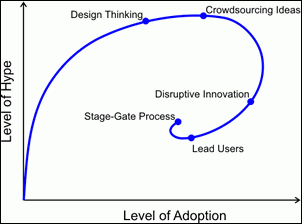
The Innovation Hype Cycle
According to the Gartner Hype Cycle model, media coverage of a new technology goes through five distinct phases. Graham Horton has discovered that the way media treats innovation follows a similar pattern.
Innovation Strategy: Matching What is Possible with What is Needed
Corporate innovation has traditionally been driven from the technology side; from departments like R&D and engineering. It’s an approach that can be very successful. Indeed, it has often led to great breakthroughs. But if a company wants to win in today’s value-based economy, this is no longer the best way of doing things.

Tips for Generating Innovative New Product Ideas from the Electronics Industry
Successful organizations worldwide realize how important it is to their success to nourish creativity and innovation. Innovation is, after all, the vanguard to increased competitiveness. In my years of experience in the development of innovative electronic products, innovation challenges have necessitated the gathering and practice of techniques from many arenas. Here are a few ideas that we have developed in my company. I hope that they will help you to expand and enable innovation in your organization, too.

Rapid Prototyping Technologies Enhance Innovation Opportunities
Rapid prototyping technologies enable innovative companies to quickly and inexpensively develop rough prototypes of new products and components - which can help them to nurture an innovative design through multiple iterations and bring the final product to market faster. As such, it represents a potentially potent innovation edge.
Open innovation sounds good, but how can scientists apply it in the lab?
Open innovation expands opportunities for success by encouraging innovators to look outside their organizations for potential technologies and solutions that could be adapted to the challenge at hand. However, its utility and value to R&D teams depends on the ability of scientists to make sense out of open innovation. Dr. Ali Alwattari explains how.
How to creatively leverage benefits from new technology – and beat your competition
Read this article to discover how becoming an 'early adopter' of technology can help you stay one step ahead of your competition.
Take time for ‘think time’
In today's fast-paced world, few of us take quiet time for creative thinking and problem solving. But we should!