

Open Data Strategy by the EC: “The best way to get value from data is to give it away”
The European Commission (EC) has launched a new open data strategy that will see a vast number of datasets owned by public authorities released to the public. The EC anticipates that the data will see businesses make money from new smart phone apps that may include maps, real-time traffic information or price comparison tools for example. The strategy is expected to boost to the EU's economy by €40 billion each year.

Pulp Innovation Chapter XL: Protecting IP in an Open Innovation Community
Now that Accipiter has decided to create an open innovation community it’s time to iron out the details. The IT department has clear concerns about data privacy and security. Meanwhile, Marlowe narrows in on the community goals and making sure they map those goals to the selected software.

3 Big Benefits of Visual Thinking
Exciting times ahead for innovation managers who understand the value of thinking in pictures. Here's why.
Mobilising Health Apps
Mobile health apps are set to change the way individuals can look after their health, doctors can diagnose and monitor patients, and medical research can collect data and develop their research. As health apps go from ‘dumb’, i.e. use only aggregated or limited personal data to intelligent using personalised health records and genetic data, a revolution may be underway.
One Out of Seven is Ridiculous
Suppose you are a professional soccer player, chosen to kick the penalties for your team. And you scored only one out of seven penalties. Would you be satisfied? How long do you think your trainer and fellow players let you take penalties? They would probably kick you out of the team after the second failure in a row.
Collaborative Innovation on the Retail Floor at Nordstrom’s
By combining physical and digital elements in our innovation experiments, we can often uncover significant opportunities that weren't apparent before. Dan Keldsen shares a fascinating example from a retail setting.
How Social Technologies Transform Organizations
The McKinsey Institute published the results of their fifth annual survey on how organizations use social technologies, it surveyed 4,200 executives to understand the developments and progress throughout the years and benefits of these social technology applications. They are being deployed for the purpose of process enhancements and operations. Secondly they’re being used to find new growth opportunities. Surprisingly, a large percentage of organizations did not maintain the benefits of using social technologies that they had achieved earlier.
Pulp Innovation Chapter XXXIX: Follow the Innovation Leader
Marlowe struggles with a client who has decided to build an innovation community in 90 days without any consideration for the structure, support and funding to carry out such an operation. Can Marlowe manage to take the lead or will they develop a half-hearted endeavor to collect ideas?

Intellectual Property: Undervalued by Global Risk Management Community
Global organisations are largely failing to understand the intellectual property (IP) risks facing their organisations and the value of their intangible assets, according to a worldwide report by Marsh and Liberty International Underwriters (LIU). In the 2011 Intellectual Property Survey Report, three-quarters of respondents were unable to quantify the proportion of their firms’ value that could be attributed to intangible assets or goodwill. This is despite almost 70% of firms identifying the protection of IP as a crucial incentive to innovation in their firms.
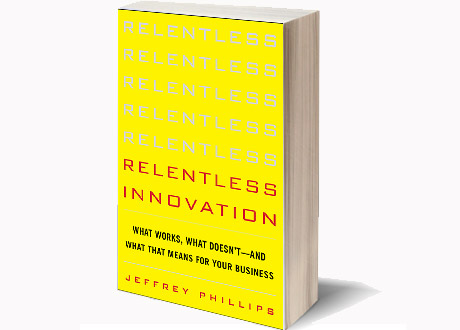
Book Review: Relentless Innovation
In his new book Relentless Innovation, prolific innovation author Jeffrey Phillips looks at innovation from an enterprise-level perspective, encouraging companies to adopt an innovation capability that can be scaled and repeated throughout the firm, rather than attempt the one-off innovation initiatives that are common to big businesses today.
A Business Model Innovation Lesson in Personal Sanitation Products
Kay Plantes never thought toilets could be so interesting. During a recent trip to China, she realized that they provide a rich example of thinking beyond one product when pursuing innovation.
Why do Most Products Fail? 3 Techniques to Leverage Hidden Needs
Many managers want their organizations to develop breakthrough products and ask their R&D departments to come up with the equivalent of the iPod or iPhone. Unfortunately, the reality is that product failure is more common than success. So what are the reasons for product failure and what steps can companies take to avoid it?
Moving from the Front to the Back End of Innovation: Idea Evaluation
People who practice collaborative innovation learn how to craft a series of engagements where participants can see the whole—the whole problem and the whole set of potential solutions—in order to reach a shared understanding of the way forward. In articulating the way forward, idea by idea, the group commits to a larger strategic intent. In this article, I describe a way in which practitioners can craft an engagement in which participants can reach a shared understanding of which ideas to pursue from the front to the back end of innovation.
35 Ways to Cultivate Innovation and Organizational Learning
Innovation and organizational learning are inextricably connected. A company must learn from its mistakes and cultivate multiple pathways for recognizing and leveraging the best ideas effectively, whether those ideas come from inside or outside of the organization, says Jim Clemmer. Here are 35 ways to sharpen your organizational "innovation radar," to accelerate learning cycles and recognize and capitalize on opportunities faster.
How to Accelerate Open Innovation Initiatives with Disruptive Technology
Global companies focused on open innovation can accelerate corporate innovation strategies by partnering with a select set of early stage, disruptive technology providers. The result can accelerate open innovation initiatives to fulfill existing market needs or to access new market opportunities while leveraging intellectual resources from outside your organization.
Pulp Innovation XXXVIII: Innovation Strategy Change
When Accipiter suddenly changes game plan from a skunkwors to an innovation community, Marlowe barely has time to catch his breath before starting to advise on the new structure and goals.

Get Engaged in Next Generation Innovation – Best Practices and Success Stories
In this IM Channel One webinar we look at how innovation life cycle processes and structures can be put in place to motivate, manage and move thousands of people into next generation innovation communities. The experts at Induct share important findings from their last three years of studies and research projects from innovation practice.
5 Steps to Increase Innovation Skill Sets
"This company needs to be more innovative!" Sounds familiar, doesn't it? But what happens next? Because a true change in how innovative a company is must also reflect a change in the skills of employees that are related to innovation. Which, of course, begs the question: Is innovation a skill set that all employees can acquire? Can employees that are not innovative learn how to be? And, if so, what are these skills? How are improvements in them measured? In this article Dr. Mark Juszczak attempts to provide HR practitioners with some guidelines and a background into the competencies linked to innovation and the extent to which such competencies are teachable.
4 Key Success Factors That Can Enable a Higher Return on Innovation
In a slow or no-growth environment, we know successful innovation is absolutely essential for companies to establish and maintain a competitive advantage. While that may be yesterday’s news, achieving it is hard work. How can you achieve high value from your innovation initiatives? In this article Adi Alon discusses four key success factors that can help you get a higher return on innovation.
Innovating with Bug Power
Clean water and clean power, especially in remote areas of Africa and other developing nations, are critical challenges. One piece of technology, Microbial Fuel Cells, (MFCs) could help address both problems, and bring the additional benefits of mobile communications - changing the lives of millions. In one incarnation, it might also reduce the scourge of malaria.

7 Powerful Creative Thinking Hacks from Scott Berkun
We all need help getting out of our well-worn thinking ruts from time to time. When your work or life demands a creative solution but your muse has gone AWOL, why not try one or more of these creative thinking hacks from Scott Berkun's new book, Mindfire: Big Ideas for Curious Minds?
Managing Trade-offs Effectively when Adopting External Innovations
Most companies don't think through the trade-off between utilizing an external innovation as is versus customizing it nearly enough. As a result, they tend to suffer in time to market.
40 Reasons Why People Struggle with Innovation
The fuzzy front end of innovation confronts you with a lot of questions. For the new edition of my book ‘Creating innovative Products and Services' I have posted a question on front-end innovation struggles to innovation practioners in more than 20 linkedin groups. The response was massive. I made a list of forty reasons why people struggle starting innovation in their companies in daily practice.

The Hidden Driver of Innovation at Apple – Revealed
One of the things that's becoming abundantly clear from reading Walter Isaacson's biography of Steve Jobs is that a key to the company's innovation wasn't just Jobs' prodigious talent and relentless drive for creating "insanely great" products. There was also another element that I haven't seen anyone talking about as they eulogize this technology giant.