


Want Breakthrough Innovation? Then Don’t Listen to your Customers
Crowdsourcing and customer-focused innovation are very popular today. But by themselves, they're not a very good way to achieve breakthrough innovation, warns Jeffrey Baumgartner.

10 Open Innovation Questions for SME’s
As a follow-up to my slightly provocative blog post, Why Open Innovation is Not for Small Companies, I have begun looking further into the interesting topic on how small companies can innovate with others.
Changing Mental Models to Make Innovation Work
We see a lot of programs being run in companies in the name of innovation. Of course some of the large corporations need to run innovation programs for name sake. They need some window dressing for analysts and industry observers lambasting the same for not being innovative enough.
Innovation in South America
According to the last INSEAD Global Innovation Index 2009-2010, all South American countries are ranked below the 40th position. To improve the innovation situation in the region there are three main focus areas to be addressed: encouraging a culture of collaboration and the use of social media, encouraging intrapreneurs, and to introduce Management 2.0. Other key issues are Internet penetration and the Enterprise 2.0 concept.

Weak signals, connections and leveraging networks are keys to creativity: Smyre
To creatively prepare for the future in an era of great transition, we need to pay attention to weak signals and look for conections in everything, says futurist Rick Smyre.
How Partners React to an Open Innovation Strategy
I have cited Psion Teklogix, provider of rugged mobile computers, several times on my blog for their promising approach to open innovation. Last month, the company took a big step forward with its strategic interpretation of open innovation – called Open Source Mobility (OSM) – when it brought its global partners together for a series of conferences at which they unveiled a new platform designed to give resellers and developer partners the opportunity to co-create with Psion.
Is Corporate Venture Dead? Is Open Innovation the New Thing?
Once upon a time, we had many corporate venture units that invested in external projects as well as in internal projects from the corporate groups that they belonged to.
Creativity is key to organizational and individual sustainability, says Annalie Killian
Creativity is not only essential to the sustainability of organizations, it's also key to individual health and happiness, points out maverick woman Annalie Killian.
From Science to Business – How Firms Create Value by Partnering with Universities
In today’s “knowledge-based” society, it is becoming increasingly imperative for companies to “mine” knowledge and technology generated by universities. Why? Because the outcome of such industry-university collaborations help companies create new activities and jobs.

Stephen Shapiro explains why open innovation is the new paradigm of work
Stephen Shapiro explains the thinking behind open creativity and why he wrote a book and created a card deck called Personality Poker.
The Future of Innovation: GE’s Ecomagination Challenge
GE got their share of the headlines in the innovation community last month. I think it is well deserved as they gave us a very good example on how innovation is shaping up in the corporate world with their Ecomagination Challenge.
Top 10 Reasons for Open Innovation Failure
A recent 15inno Twitter Chat made me ponder on the worst and most common mistakes that companies do on open innovation. Here comes a list of my thoughts – still work in progress.
How to Develop a Creative ‘Elevator Pitch’ that Captures Attention and Interest
To sell ourselves and our big ideas, we need elevator pitches that stand out, are unique and stimulate a response. Clearly, some creativity is what is needed to design such a pitch. Jeffrey Baumgartner explains how to develop one.
Technology Scouting: Rethinking the Innovation Toolbox
Companies should reconsider their technology scouting strategies to proactively seek, identify and access external knowledge, skills, capabilities and intellectual assets. These may or may not be applicable to their current needs. However, these resources could quickly be activated to help address new challenges as they arise. Sort of an innovation toolbox, according to Michael Fruhling.
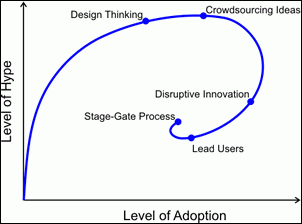
The Innovation Hype Cycle
According to the Gartner Hype Cycle model, media coverage of a new technology goes through five distinct phases. Graham Horton has discovered that the way media treats innovation follows a similar pattern.
Collaborating Downstream in Emerging Markets
Not so long ago, internal R&D activities were considered one of the most valuable assets a company could have. The rather “outmoded” concept of closed innovation, in contrast to open innovation, was built on self-reliance and on the principle that successful innovation required control and secrecy.
Co-Innovating for the Future
Realising the limitations of their own knowledge, and internal R&D capabilities, an increasingly high number of companies are currently making the decision of partnering externally to develop new technologies. Companies’ interactions with their business partners or even competitors are becoming more and more frequent.
Saving the Climate is Saving the Business – Aligning Sustainable and Open Innovation
''Climate change is a result of the greatest market failure the world has seen. The evidence on the seriousness of the risks from inaction or delayed action is now overwhelming. We risk damage on a scale larger than the two world wars of the last century. The problem is global and the response must be a collaboration on a global scale.'' (Professor Lord Nicholas Stern, London School of Economics, at Royal Economic Society Manchester, November 2007, guardian.co.uk)

Web-Enabled Open Innovation: From Hype to Reality
InnovationManagemenet is proud to present yet another experienced and knowledgeable columnist; Ehsan Ehsani, researcher and consultant in the area of innovation and product development. Ehsan is working with Accenture Product Innovation and PLM practice in New York City Office and has previous experience from a variety of firms both in Europe and the United States. This is the first in a series of columns starting off with a hot topic: Web-enabled open innovation.
Three levels of open innovation maturity
There are three levels of open innovation maturity: externally aware, fully integrated and ecosystem orchestration. Innovation and growth performance improve as maturity increases.
How to find potential open innovation partners
The world if filled with incredibly smart people. If you can locate them and convince them to partner with you, they can help to drive your open innovation efforts forward. Stefan Lindegaard shares several strategies for making that happen.
Is open innovation over-hyped?
Open innovation has been hyped in the media and by some consulting firms over the past few years as the next new thing and is just giving a term to an activity that has been underway in business for a long time. Simply put, open innovation is partnering to gain leverage and build barriers to competition.
Government’s promising role in fostering open innovation
One key partner that has the potential to greatly affect and enhance the human condition is government. This author prefers the open market as the main catalyst for change, but given the complexity and scale of certain types of research, government can play a vital role in advancing knowledge in science and technology by supporting basic research. While some governments have been funding research for quite some time, the inefficiency of the process may be keeping new discoveries from being commercialized.

How to Avoid Open Innovation Failure
Make sure your internal innovation capabilities and processes are in order before you open up your idea and innovation strategy to the world.