

10 Skills You Need to Nurture in Your Innovation Group
Organizational innovation requires discipline. And like any other discipline, it requires monitoring and training to make sure that you’re on the cutting edge of your capabilities. But what skills should you focus on building and how can you track your progress?
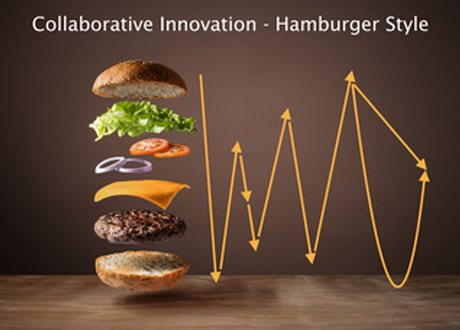
Collaborative Innovation – Hamburger Style
Often I read articles or books about top-down vs. bottom-up innovation and why one approach would be better than the other. After spending more than five years in the collaborative innovation space, I would advise going hamburger style!

Organizing within Networks of Collaborators
Our existing organization needs to envisage a changing world full of disruption that calls for radical change. To meet different challenges, to be highly adaptive it needs to begin to organize around ecosystems to deliver on a vision that recognizes it has to be part of a greater collaborating network to thrive in this highly connected world.

What Do Innovators Look Like?
Crowdsourced innovation is a tactic used more and more often by government organizations as well as enterprise corporations. This means that innovation teams need to add a new skill set to their resumé: communications.

Picking the Right Stakeholders for Open Innovation
What external stakeholder groups can you tap into to build value for your innovation initiatives? Are your relationships with these external stakeholder groups solid or do you need to do additional work to build good, mutually beneficial working relationships? Are there potential stakeholder groups that you have not yet tapped at all? If so, what is your plan for reaching out to organizations within these pools so that you can further expand your innovation ecosystem? Are your channels for communicating with your external stakeholders strong or do they need further work?
A Quick Guide to External Collaboration
Working with external partners to bring better products and services to market faster and/or develop better intellectual property has never been more popular in the world of business than what we see today.
The Four Essential Steps Towards Open Innovation Success
Although ‘open innovation’ is the talk of the town in R&D circles, leveraging external sources of innovation remains challenging for most companies. In 2013, researchers Dr. Joel West (Keck Graduate, Institute of Applied Life Sciences) and Dr. Marcel Bogers (University of Southern Denmark) suggested a four-phase model for inbound innovation projects. They emphasized that open innovation needs to go further than just obtaining external ideas. Integration, commercialization and the interaction between the firm and its collaborators are just as important. This post explores the four essential steps towards open innovation success.
Is Open Government the Same as Open Innovation?
For many years, companies were convinced of the competitive advantage of closed research and development. They jealously protected their intellectual property behind closed doors and dramatically revealed it to the public after years of development. This old model has since been replaced by open innovation.
Three Types of Networkers and the Roadblocks for Corporate Networking
As you determine how to build a networking culture within your organization, it’s important to understand how networking actually works. One of the most knowledgeable people on organizational networking and—how this supports innovation—is Rob Cross, a professor in the management department of University of Virginia's McIntire School of Commerce.
The Importance of Collaboration in the Digital Economy
What’s the future for the connected car, for digital financial services, or for smart and sustainable cities in the new industrial reality? How are innovations and technical developments in 5G, the Internet of Things and spectrum management impacting on future networks and future businesses? And if meaningful, affordable connectivity is the single best bet for accelerating socio-economic development and meeting the UN’s sustainable development goals (SDGs), how can we ensure we reach the billions of unconnected most in need?
Building an Innovative Nonprofit: the Value of Crowdsourcing
Crowdsourcing is often associated with start-ups and blue-chip companies who are trying to innovate, but it has the potential to reach far beyond those with seed money and infinite endowments. The beauty of crowdsourcing is that it is rooted in grassroots fundamentals—an environment that is ideal for non-profit businesses.
Defeating the Corporate Antibodies
Change is frightening to many elements inside the typical organization. Change threatens people’s power, their status, their egos, and, in some situations, even their jobs. Change can make someone’s expertise obsolete and thereby make them obsolete as well. Because people are afraid of change, innovation efforts often cause the eruption of corporate antibodies that fight to kill innovation and maintain the status quo.
Metrics and Measurements for Open Innovation and Ecosystems
Given the difficulties in developing and working with metrics and measures for open innovation and ecosystems, I have pulled together some inspiration and insights from several articles.
The Next Level of Open Innovation: Is Your Organization Ready?
Getting started with open innovation and developing the right foundation for open innovation has been a key challenge at many companies in the last three to five years. Now, internal as well as external forces are moving these companies towards the next level of open innovation in which we go beyond just products and technology and start to explore how a more open and collaborative mindset can be applied to all more business units and functions. Think procurement and engineering as examples.
Mad Scientists and Creativity Labs
Managing solitary and collaborative innovation: All innovation is based on creative ideas which are generated and developed by passionate people working alone and with others. Both solitary and collaborative work are important to the effective development of innovation in organizations. The key for leaders is to effectively promote both.
From Bankruptcy to Industry Leading Success – The LEGO Story
LEGO has earned the right to celebrate. Not only are kids playing with more mini LEGO people than there are human beings on the planet (Delingpole J, 2009) but in 2015, they were nominated by Forbes as the most powerful brand in the world. For a company which was on the brink of bankruptcy in 2004, the toy maker has made an amazing turnaround. They restructured, hired a new CEO, and forged more licensing partnerships than ever before. Most importantly, they discovered the secret to some of the world’s most successful, low risk innovation strategies.
Opening the Floodgates of Innovation: Insights from Deloitte Innovation Day
Take a quick glance around your office. What do you see? Categorically “Start-up” types in t-shirts and jeans passing bottles of craft beer around? Or “Suits”, with their collars starched to perfection, hunched over their laptops and scrambling away at emails? What would happen if we flipped these scenarios around? I for one, would love to see my accountant rock up to work in a Hawaiian Shirt; a calculator in one hand, and a piña colada in the other. But what difference would this make?

Why Crowdsourcing is Critical to the Future of Education
Educational institutions have the reputation of being slow-moving behemoths, but this label is undeserved. According to the Organization of Economic Cooperation and Development, the educational sector worldwide is more innovative than it gets credit for.

Digital Shoring for Networked Innovation
Companies are under pressure to innovate faster than ever, and collaboration beyond organizational boundaries is central to accelerated innovation. But few companies navigate collaboration well—or even find the right path to get started. To move forward, companies must change their operating models to enable “digital shoring,” the latest evolution of organizational “shoring” approaches.

Do You Know the Seven Stages of Innovation?
At IdeaScale, we define prolific innovators as organizations that have moved more than half of their ideas to the final stage. This doesn’t necessarily mean that every suggested idea became a value-generating, implemented reality. This means that the completed ideas had each been investigated, responded to, and a decision was made to move forward or not. But of course, at least a portion of those completed ideas generate measurable constructive outcomes.

Innovation: Knowing Where to Begin
Let me see if this situation sounds familiar: you’ve promised your boss that you’ll generate at least one percent growth over last year. You’ve been racking your brain with ideas about how to improve your product or develop a new offering or finding new efficiencies which will help your margins, but the few ideas that you’ve come up with haven’t had legs and pages keep coming off the calendar.

How Innovation Develops Among Individuals in Niche Social Networks
In the current digital arena, social networks have touched the lives of almost every human being on earth, allowing us to share life's novelties with friends and loved ones. However, social networks are not restricted to sharing and commenting on pictures, but giving rise to innovation among individuals to help make our world a better place.

Collaborative Innovation in Advanced Manufacturing: Just Getting Started
Advanced manufacturers—people who make “things”—face the same challenges in the Digital Age as their counterparts that traffic wholly in bits and bytes. Relentless immediacy. Increased transparency. In this article, the innovation architect Doug Collins reflects on the results from a survey that the analyst firm Frost & Sullivan conducted as part of the Manufacturing Leadership Council. What are the more advanced of the advanced manufacturing thinking these days about the practice of collaborative innovation? Are they on track?

Going Once, Going Twice, Going Three Times: Selling Your Idea
People cannot appreciate the value your idea offers if you fail to convey its relative advantage. In this article, the innovation architect Doug Collins shares a simple, good example of telling the right story at the right time to the right audience. Save this one for your clip file.